PeopleVine Alternatives: Why Hospitality Operators Are Moving to Tiquo

PeopleVine built a reputation as the CRM and membership platform for hospitality brands, private members’ clubs, and lifestyle venues. On paper, it handles member onboarding, branded portals, automated billing, marketing, and digital check-in. For businesses whose primary need is managing a membership lifecycle and keeping members engaged through a front-end experience, the pitch is compelling.
In practice, operators find the day-to-day reality does not match the promise. The platform has a steep learning curve that demands significant time from teams during onboarding. Parts of the system can feel unfinished, with users reporting that certain features feel more like beta releases than production-ready tools. Support can be slow when issues arise. And the roadmap, while ambitious on paper, moves slowly. Features that are promised often take years to materialise, leaving operators waiting for functionality they were told was coming.
Operators who have used PeopleVine extensively tend not to be enthusiastic about it. The general sentiment is one of tolerance rather than satisfaction – teams using it because switching feels disruptive, not because the platform is delivering what they need. That is a pattern worth paying attention to.
But the deeper issue is structural. As hospitality operators grow, particularly those running mixed-use venues, multi-site portfolios, or properties that span F&B, wellness, events, accommodation, and retail alongside their membership offering, a pattern emerges. PeopleVine handles the membership layer, but everything around it still requires separate systems. The POS is a third-party integration. The hotel PMS is another. Spa bookings live somewhere else. Event management is handled through a different workflow. Payments route through external processors. And the promise of a unified member experience breaks down at the seams between all of these tools.
Operators start looking for alternatives for two reasons: the platform itself has rough edges that create friction for staff and members, and what it covers is not enough to run the full operation.
Common Reasons Operators Leave PeopleVine
Steep learning curve. Teams spend weeks getting comfortable with the platform. In an industry with high staff turnover, that is a significant ongoing cost. The interface can feel unintuitive for both staff and members, slowing down operations during busy periods.
Features that feel unfinished. Users report that certain parts of the system feel like beta releases rather than production-ready tools. Promised functionality can take years to arrive, leaving operators stuck waiting for capabilities they were told were coming.
Inconsistent support. When things go wrong, response times can be slow, which is a real problem for hospitality businesses that cannot afford downtime.
Integration-dependent architecture. POS, PMS, bookings, ticketing, and payments all require separate third-party systems that are difficult to set up and unreliable once live. Because each integrated system has its own database, there is no single view of the customer, and reporting requires manual reconciliation across platforms.
Limited branding. The member portal and customer-facing experiences carry PeopleVine’s design rather than the operator’s brand. For venues building a premium identity, that gap between the brand they are creating and the generic platform their members actually interact with is a constant friction point.
Where PeopleVine Fits and Where It Stops
PeopleVine positions itself as a guest and member experience CRM. Its strengths sit in that lane: member applications and onboarding, subscription billing, a customisable member portal, marketing automation, and engagement tools. It offers integrations with external POS systems like Toast, Square, and Micros Simphony through PeopleVine Connect, and it can link to property management systems, booking platforms, and payment processors.
The keyword there is “integrations.” PeopleVine is not a POS. It is not a property management system. It is not a booking engine, a ticketing platform, or an event management tool. It connects to those things through third-party systems, each of which brings its own database, its own login, its own support team, and its own set of limitations.
For a single-venue private members’ club with a relatively simple operation, this model can theoretically work. In practice, even this setup often proves frustrating. Getting integrations configured and working properly is a time-consuming process, and once they are live, they frequently do not behave as expected. Data that should sync does not. Features that should work together require manual workarounds. The experience for staff on the ground can feel clunky and unreliable.
The model breaks down further when the operation gets more complex. A mixed-use property with multiple F&B outlets, a gym, event spaces, a hotel, and a retail offering generates hundreds of transactions a day across dozens of touchpoints. Each of those transactions needs to feed into the same customer profile, the same financial reporting, and the same loyalty programme. When the membership CRM, the POS, the PMS, the booking engine, and the payment gateway are all separate products connected by integrations, the data is fragmented by design. No amount of API work fully solves that.
The Integration Tax
Every integration between two systems introduces friction. Data syncs on a schedule rather than in real time. Customer records exist in slightly different formats across platforms. A member’s spending at the restaurant might not appear in their CRM profile until the next morning. A booking made through the spa system might not trigger the loyalty accrual in PeopleVine until a batch process runs overnight.
These delays and inconsistencies compound across an operation. Staff at the front desk cannot see a complete, real-time picture of a member’s activity. Marketing campaigns target members based on data that is hours or days old. Finance teams spend time reconciling revenue across systems that each calculate totals slightly differently. And when an integration breaks, which happens more often than any vendor likes to admit, the gap between systems widens until someone notices and fixes it. When it does break, you need support that responds quickly. That has been a recurring frustration for PeopleVine users.
There is also a cost dimension that is easy to underestimate. Each integrated system carries its own subscription fee. Many charge per-location or per-user pricing that scales with the business. The POS vendor charges one rate. The booking platform charges another. The payment processor takes its cut. PeopleVine itself has its pricing tier. And if the business uses a middleware layer or custom API work to connect everything, that carries ongoing development and maintenance costs.
By the time a multi-site or mixed-use operator adds up every subscription, every integration fee, and every hour of staff time spent working around the gaps between systems, the total cost of the fragmented stack often dwarfs what a unified platform would cost.
What Operators Actually Need
The operators leaving PeopleVine are not looking for a better CRM. They are looking for a platform that eliminates the need to stitch together five or six separate products to run their business.
Membership and CRM as part of the operation, not on top of it. The membership layer should be native to a platform that also handles POS, bookings, ticketing, check-ins, event management, hotel operations, and payments. Not through integrations. In a single system, sharing a single database and a single customer profile.
Instant recognition at every touchpoint. Members should be able to walk into any part of the property, whether it is a restaurant, a gym, an exhibition, a hotel, or a retail space, and be recognised immediately. Not because an integration synced their data an hour ago, but because every touchpoint reads from the same source in real time.
One tab, one payment, automatic financial splitting. A member should be able to order a coffee at one outlet, book a spa treatment at another, and charge both to their account, then settle everything with a single payment that the system automatically splits across the correct legal entities. No manual reconciliation. No cross-charging between departments.
A fully branded experience. Every touchpoint, from the booking flow to the member portal to the payment journey, should carry the operator’s brand. Members should feel like they are engaging with the venue, not with a CRM vendor.
Portfolio-wide reporting without spreadsheets. All of this should feed into a single reporting layer that gives a genuine view of revenue, customer activity, and operational performance without exporting data from six systems and hoping the numbers match.
A system that staff can actually use. The platform needs to be intuitive enough that new team members can be productive within hours, not weeks. In hospitality, if staff are fighting the system, the member experience suffers.
The Day-to-Day Experience Problem
Beyond the architectural limitations, there is a more immediate issue that operators feel every day: usability. PeopleVine’s learning curve is steep. Onboarding a new team member is not a quick process, and even experienced users report that the interface can feel unintuitive in places. Certain features feel half-built, as though they were shipped to meet a roadmap deadline rather than because they were ready. For staff using the system during a busy service or while checking in a queue of members at the front desk, these rough edges are not abstract complaints. They slow people down and create a worse experience for the members those staff are trying to serve.
A platform can have every feature in the world, but if the people using it every day find it frustrating, slow, or confusing, the business never gets the full value. Staff develop workarounds. They avoid certain features. They revert to manual processes because the system is too cumbersome for the pace of real operations.
Tiquo was designed with the opposite philosophy. The platform is intuitive to pick up, fast to set up, and built so that staff can be productive almost immediately without extensive training. The interface is clean and responsive across every device. New team members can be onboarded in a fraction of the time it takes with PeopleVine, which matters enormously in hospitality where staff turnover is high and every hour spent on training is an hour not spent on service.
How Tiquo Differs From PeopleVine
The differences go deeper than usability. Tiquo is not a CRM with integrations to operational tools. It is a unified operations platform where CRM, memberships, POS, bookings, ticketing, check-ins, event enquiries, hotel PMS, payments, and analytics are all part of the same system.
In PeopleVine’s model, the CRM is the centre and everything else connects to it from outside. In Tiquo’s model, there is no “outside.” Every function operates on the same database, the same customer profiles, and the same real-time data engine. A transaction at the POS is instantly visible in the CRM. A booking in the spa is immediately reflected in the member’s profile. A hotel checkout triggers loyalty accrual the moment it happens, not when a batch job runs later.
At a glance:
| PeopleVine | Tiquo | |
|---|---|---|
| CRM and memberships | Native | Native |
| Point of sale | Third-party integration | Native |
| Hotel PMS | Third-party integration | Native |
| Bookings and ticketing | Third-party integration | Native |
| Event management | Third-party integration | Native |
| Payments | External processors | Native with multi-entity splitting |
| Customer-facing branding | PeopleVine-branded | Fully custom to your brand |
| Analytics | CRM-level only | Full operational and predictive |
| Setup and onboarding | Steep learning curve | Intuitive, fast to deploy |
| Device support | Limited | All devices, no feature limitations |
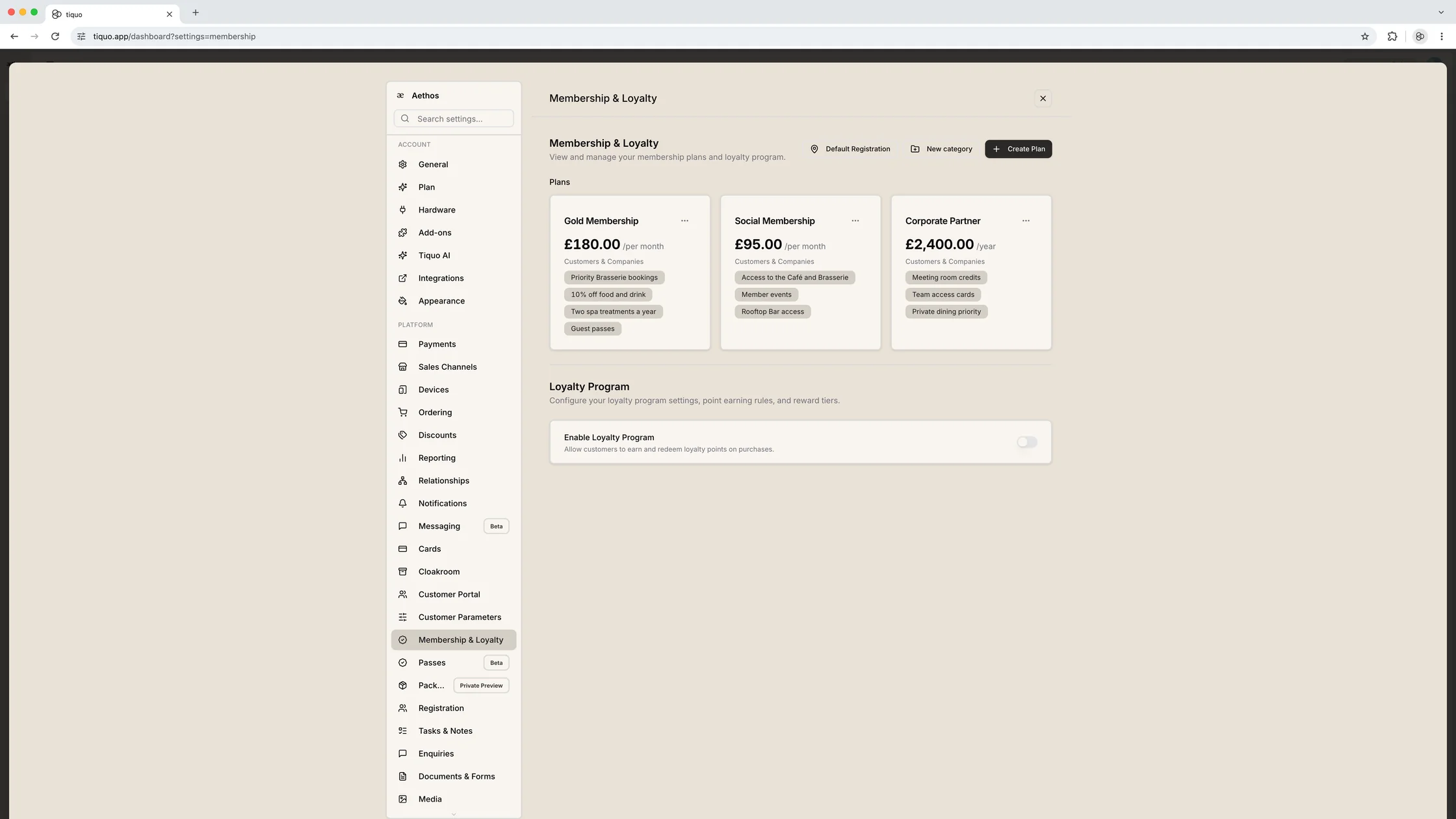
Membership and loyalty across verticals. PeopleVine manages memberships within its own platform, but extending those benefits to the POS, the spa booking system, and the hotel PMS depends on integrations. Tiquo’s unified loyalty and membership commerce means members earn, redeem, and manage benefits across every sub-location natively. A member can earn points from a restaurant visit, redeem them against a spa treatment, and check their balance from their phone, all within the same system. Gift cards work the same way, redeemable across all brands and verticals with full control over which locations accept them.
Point of sale. PeopleVine relies on external POS providers connected through PeopleVine Connect. Tiquo’s POS is built in. It handles orders, payments, and product management across every outlet, and because it shares the same database as the CRM, every transaction automatically enriches the customer profile. Multi-location open tabs let members add orders from different outlets onto a single bill and settle with one payment.
Payments and financial operations. PeopleVine processes payments through external payment processors. Tiquo’s intelligent multi-entity payments take a single payment and automatically split it across the correct legal entities with instant invoicing. There is no cross-charging, no reconciliation, and no end-of-month cleanup. Club Pay lets members charge anything to their account and settle from their phone. Split payments support equal splits, item-level splits, percentage splits, and custom splits across dozens of payment methods.
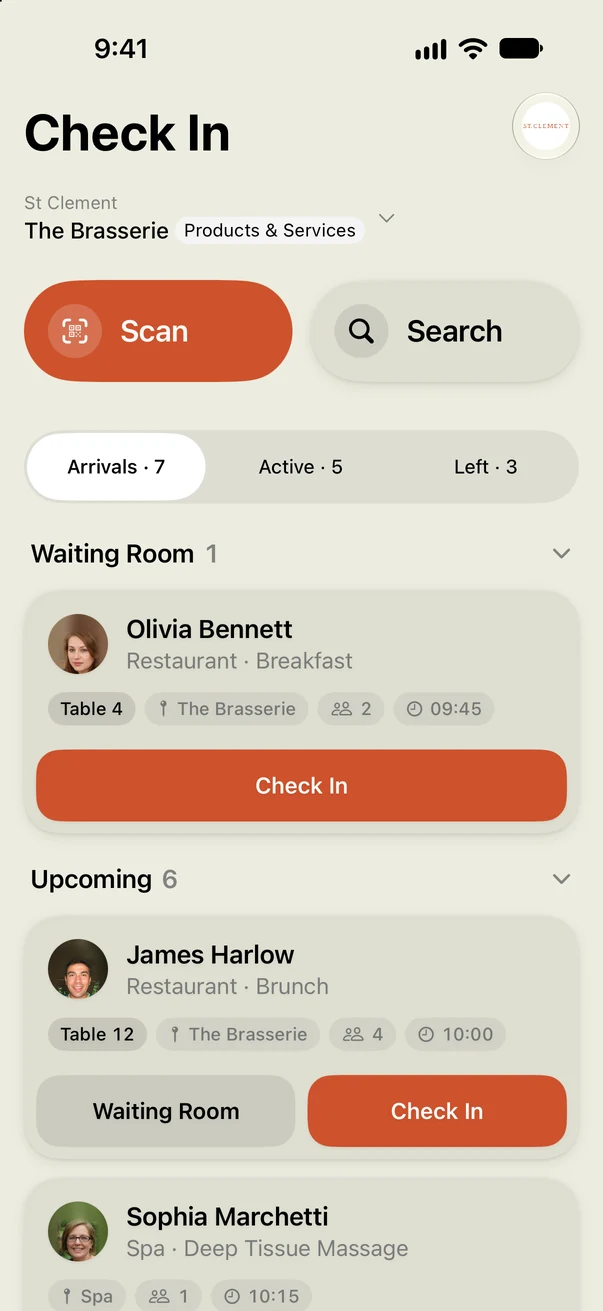
Check-in and access. PeopleVine offers digital check-in through its member portal. Tiquo extends this across every reception and entrance point in the property, verifying membership status, tenancy, booking validity, or guest credentials in real time. Passwordless authentication works on any device, and Apple and Google Wallet integration means membership cards live on the member’s phone.
Bookings, events, and hotel operations. These are areas PeopleVine does not cover natively. Spa bookings, exhibition ticketing, private hire event management, and hotel PMS all require separate systems in a PeopleVine setup. In Tiquo, they are all native. A member booking a spa treatment, buying exhibition tickets, enquiring about a private event, or checking into a hotel room is interacting with the same platform throughout.
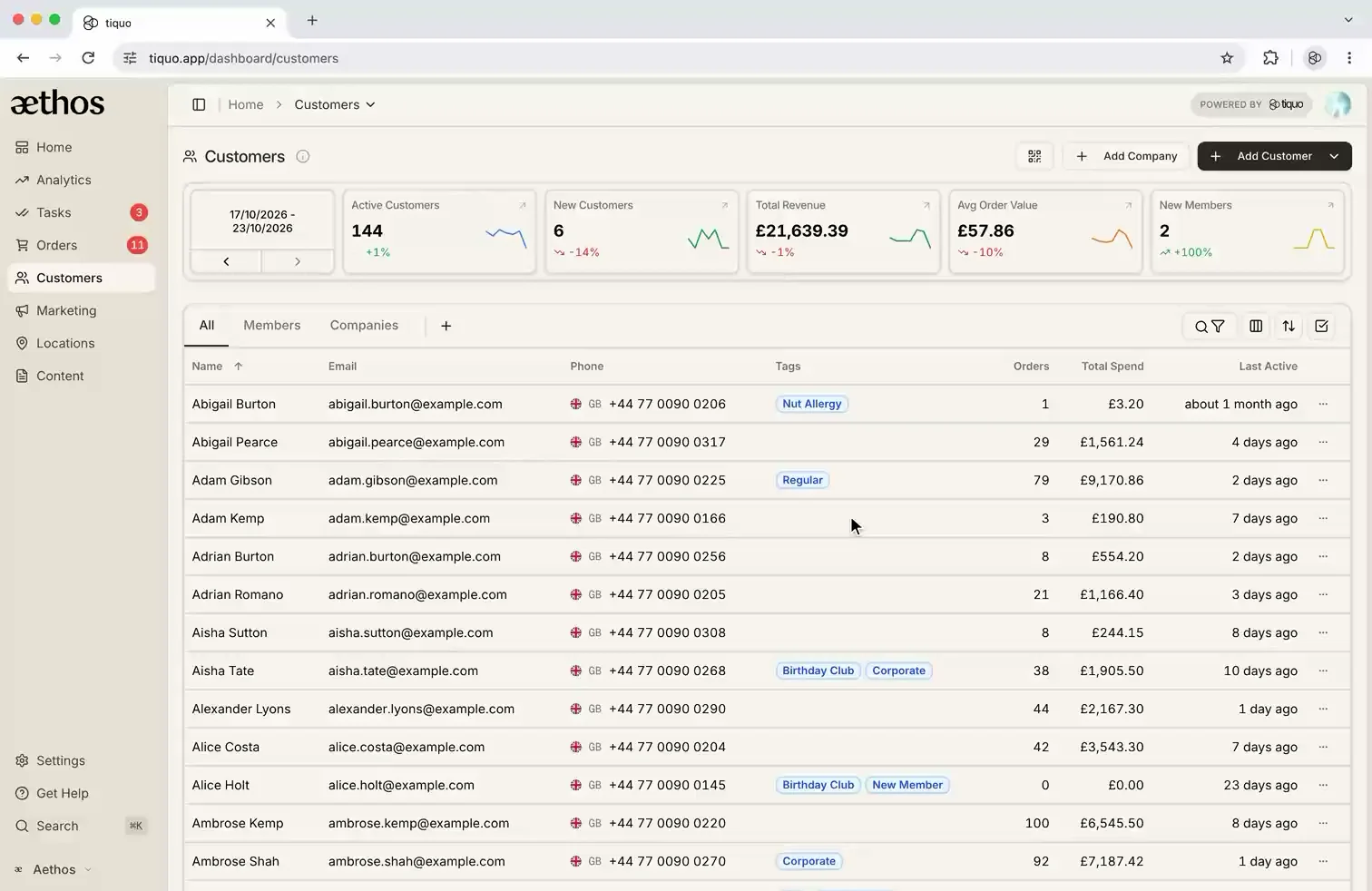
Data and analytics. PeopleVine provides CRM-level analytics on member engagement and marketing performance. Tiquo’s analytics span the entire operation. The predictive analytics suite forecasts customer behaviour, projects revenue, and calculates detailed customer lifetime value based on activity across every vertical. The automated social graph maps relationships between members, revealing who books together, who refers new members, and how social circles overlap. Portfolio-level insights let operators view revenue, performance, and customer activity across all properties and brands from a single dashboard.
The Migration Question
One of the reasons operators stay on PeopleVine longer than they should is the perceived difficulty of moving away. Years of member data, billing histories, and engagement records are locked into the platform, and the prospect of extracting and migrating all of that feels daunting.
Tiquo’s migration process begins with a comprehensive data import that consolidates all existing customer records, order histories, membership data, and transactional records from PeopleVine and every other system in the stack. The data engine handles deduplication, format standardisation, and identity resolution, building a single unified profile for every member from what was previously scattered across multiple databases.
The operational rollout is phased, not a big-bang cutover. Each function, from POS to check-ins to bookings, is deployed incrementally so that teams can adapt without disruption and the business never experiences a gap in service. And because Tiquo is intuitive by design, the retraining burden that makes PeopleVine migrations feel so daunting simply is not there. Staff pick up the new system quickly, often within a single shift, because the interface was built around how hospitality teams actually work rather than around the internal logic of the software.
Signs It Is Time to Move On
Not every business needs to move off PeopleVine. But if any of the following sound familiar, it is worth evaluating alternatives.
You are paying for three or more separate systems on top of PeopleVine to run your operation. Your integrations break regularly and take too long to fix. Staff avoid using certain features because they are too slow or unreliable. New team members take weeks to get comfortable with the platform. You have been waiting months or years for features that were promised on the roadmap.
You cannot see a single, real-time view of a member’s activity across all locations and verticals. Your finance team spends days every month reconciling revenue across systems. Members have a disjointed experience when they move between different parts of your property. The member-facing experience carries PeopleVine’s branding, not yours.
If your operation spans multiple venues, multiple verticals, or multiple entities, and you find yourself managing a growing stack of integrated tools just to keep the business running, the question is not whether PeopleVine is functional at what it does. The question is whether what it does is enough.
For operators who need a single platform that handles memberships, CRM, POS, bookings, ticketing, check-ins, events, hotel management, payments, and analytics in one place, Tiquo was built for exactly that.
Latest Stories
SevenRooms Alternatives: When Reservation Software Starts Becoming the Centre of Everything
There is a version of “knowing your guests” that SevenRooms attempts. The tension is what that actually means once the business becomes more complex.
OfficeRnD Alternatives: When Decent Workspace Software Is No Longer Enough
OfficeRnD is a functional product built for coworking, flex space, and hybrid workplace operators. The catch is that it stays in that category even as the business around it grows.
OpenTable Alternatives: When Reservation Fees Start Feeling Like a Tax on Growth
OpenTable solves two problems at once, which is why so many restaurants end up on it. The issue is the model underneath it: as a restaurant gets busier, the bill gets bigger.